Saturday, November 24, 2012

The Energy Quota


The holiday season has officially arrived. Here in the US, we have just celebrated Thanksgiving which then opens the floodgates to the many celebrations held in December. It's a time where we tend to socialize, eat and drink as well as spend more cash than usual. We arrive at New Years Day wondering what hit us and how did it seem to spin out of control? When the credit card bill arrives mid-January did we go beyond our limits? How about your own personal physical limits?

This leads me to my thought of the week-do you know your energy budget?

I was talking with a friend whose sister has chronic fatigue and has dealt with it for the past decade. She recently adopted a child and was as happy as ever. I asked my friend, "how does she keep up with a young child with her chronic fatigue?". She replied, "she knows how to manage the limited energy that she has".

This is true for all of us whether we're a teen or somebody dealing with an illness. We all have an energy quota. The energy quota is a term I've coined that relates to how much energy expenditure we can handle in a day. But it's a bit tricky as it can shift without us realizing it. We go to work/school, we're busy so we don't really stop for lunch but just grab a bite. We have a project with a deadline so we stay later than the standard time. This results in us grabbing something on the way home that's either take out food or an easy to prepare meal at home. We're already tired so we plop down on the couch or head back to the laptop and as we find ourselves dozing off, we head off to bed.

We've gone into debt with our own energy quota. We missed the signs that our body was asking to stop, slow down or take a break. And, oh yeah, could you put something of high nourishment into the tank in the process?

I've been doing the energy quota dance for as long as I can remember. It simply began with believing that I had an endless supply of energy and that the quota was something that other people had, not people like me who were always told "you have so much energy!". Then it hit me. It didn't just sneak up and if it did, I continued to ignore the sneaking up, but it slammed me with a full on body blow. The type of experience where your body no longer whispers to you to slow down, but begins to scream at you...yelling "I said S L O W D O W N!". As a result instead of boundless energy, I had boundless fatigue. Why was I always so tired? Why didn't coffee in the morning fix it?

It's at moments like these that we get to know our energy quota. We realize that we've overspent and now it's time to pay attention to our budget. For me, this included getting enough sleep by going to bed around the same time every night and not burning the proverbial candle at both ends. It also meant drinking way less alcohol and caffeine. It meant becoming a better vegetarian and committing to practices that serve and support my life rather than constantly testing its boundaries.

My yoga practice has been the perfect antidote for overstepping my energy quota. It has helped me establish ritualized practices where I connect to my higher self and listen to my inner voice. I still tend to throw many balls into the air. I feel life is short and an abundance of opportunities await. And I am still constantly re-defining my quota, particularly as I age.

So...do you know your energy quota? If not, perhaps now is the time to acknowledge that you have one and learn a bit more about it. I figure in the end...we can all find the perfect balance.

Saturday, November 17, 2012

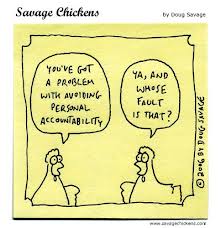
The Blame Game


You hear it all the time, "it's so and so's fault...they made me do it...they're the reason we're in the mess" and on it goes. It's a well played out scene with the lamp being broken as kids are playing in the living room and saying, "the dog did it". Lately, my awareness around the need to blame others has been heightened. Perhaps it was the election that sparked this sense that people have a bad case of finger pointing but it wasn't the election by itself as it seems to be happening a lot lately in other realms.

As I was doing an introduction to a yoga class the other day, I was commenting on how we really want to listen to what our bodies are telling us during the practice. If your body senses pain or a reaction of "I don't want to do that" then listen and respond from a place of compassion. We come into our yoga practice to reduce suffering, not to increase it and paying attention to our internal cues is vitally important to that process. Although we go to people for guidance, such as a yoga class or a personal trainer, ultimately it is only you that pushes you.

I have heard countless times how an instructor "had me do this or that" with the storyteller then saying that because of it, they got injured or had incredible soreness for days. I understand and appreciate that students put trust in their teachers. We assume that they are qualified and will provide the safest possible environment. We anticipate that they wouldn't do anything to intentionally injure or damage us and I believe that this is largely true.

But what about the times when you go to a large class that has a ratio of 1:15 or more? How can the instructor know what is completely safe for everyone? What if there's just one person in the class that seems to be lagging behind everyone else, so the instructor caters to the majority? This isn't a new topic from me. We need to be the ones who are responsible for ourselves. Period (or full stop, for my Aussie mates!). We are the ones who ultimately decide what is best for our body as we are the ones who know our bodies best.

What is a new topic is how quickly we lay blame onto something outside of ourselves. At times I just feel like yelling out, "own your own stuff!" and quit assigning blame to avoid doing so. This is a challenging practice as we often have to swallow a big lump of pride and admit that it was our own doing, our own choosing that caused the suffering. Imagine what would happen if people took responsibility for their own choices more often. If they simply acknowledged that they made a poor choice, it taught them a lesson and as a result, they have become wiser for future situations.

The blame continuum can stretch from people who complain about seemingly everyone and everything, to those who simply don't want to own up to something. It all catches up with us eventually. Satya, or truthfulness is one of the Niyamas in the eight-faceted path of the yoga sutras. At the close of each class, I end with "May we always know our truth. May we always speak our truth. And may we always live our truth". Perhaps sitting with this idea every day will give us an opportunity to control what we can and let go of the rest...without playing the blame game.

Own it.

Saturday, November 10, 2012

The Zone


If you ask most people, I think they would say they would prefer to be comfortable rather than uncomfortable. Whether it relates to what you're wearing on a particular day, being in a social setting, at work or in the body, we seek to feel at ease.

I find myself frequently asking yoga students to find a place of ease in a pose, to let go of struggling or to find ease in their breath. When we are trying something that is unfamiliar, it can make us uncomfortable and as a result we tense our muscles and hold our breath. Finding ease in a place that's challenging offers us an opportunity to move out of our comfort zone in a more comfortable way.

So why do we need to move out of our comfort zone? And do you really know what your zone is? We each have a way of being in the world and it's as individual as our fingerprint. Aren't we constantly doing this dance between trying new things but not to the point that we feel we'll fail or look bad?

One of my favorite sayings from Judith Hanson Lasater is, "does this feel painful/uncomfortable or just unfamiliar?" I love this because it offers a subtle distinction between what we know and what we don't. When we explore an unfamiliar feeling or experience, it opens up a doorway to a new sensation, expanding our zone of what we know and can do.

My zone has been challenged throughout this year from the moment I was deciding whether or not to do the Global Seva Challenge through Off the Mat, Into the World. The aim was to raise awareness around the issue of sex trafficking in India and worldwide and, in the process, to raise money to support programs and partners already in place in India that are rescuing girls from the trade. Any participant who raises $20,000 can go on the Bare Witness Tour to India to see what the organization has been supporting.

One of my initial responses was that if I was going to do the challenge, then I really wanted to raise the $20K. But how? I haven't been a fundraiser since selling chocolate bars door to door for my Bobby Sox softball league when I was nine. What did I know about raising that much money. And what was even more challenging is that I would have to find a voice to ask people for support...in a multitude of ways. I recognized that if I were to undertake the challenge that I couldn't do it by myself and that meant stepping out of one of my major comfort zones of asking for help. I have always been fiercely independent with the defiant two year old persona of "I can do it myself", so to say to someone "can you give me a hand" was likely to get stuck in my throat.

But the most amazing thing happened.

When I recognized that the only thing holding me back was asking for help and finding the words, I realized I was willing to take a chance. So I took a deep breath, honored the sick feeling in my stomach and asked anyway. My fear almost got in the way of not doing it. My fear of being told "no". My fear of trying to reach the goal and failing. My fear of trying something that I had no idea how to do. But something deeper within bubbled up and recognized my own suffering was easily overcome in order to do something significant for someone else whose suffering was unthinkable.

And although people did say "no" and didn't offer support, more people did. So many people in fact turned up and said "yes-how can I help?" that not only have I reached the goal, I've surpassed it. In the process I have changed. My zone has expanded, my skill set has grown, my confidence as a leader has been altered forever and I have this almost inexplicable feeling of love and joy at the idea of community coming together.

It's because I took a risk and stepped out of my comfort zone. I could have shirked away and said "that's too hard", but I didn't. This is why we step out of what makes us comfortable...so we can redefine our own zone. So we can be more at ease in the face of challenge.

Please take a deep breath into that scary space within, see what arises and take a chance...it might just knock your socks off!

Saturday, November 3, 2012

It's Just Diet and Exercise, Right?


We have had it drummed into our heads that if we eat "right" and move our bodies on a consistent basis then we'll live a long and healthy life. Our culture gives an incredible amount of energy into these two facets of how we can choose to live.

But is that enough?

Apparently not, according to researchers who've studied groups of people who live well and actively into their 90's and 100's. They found pockets of people around the world who as a collective outlive all others, en masse. They termed these groups Blue Zones with author Dan Buettner writing the book "The Blue Zones: Lessons for Living Longer from people who lived the longest." Basically it's a concept used to identify a demographic and/or geographic area of the world where people live measurably longer lives.

These communities were found in:

What they all had in common
  • Just move - Active lifestyles, more than heavy exercise, is what leads most to longevity.
  • Purposeful outlook - Have clarity about your role in life.
  • Down shift on stress - Blue zone cultures all have their own ways of shedding stress in life.
  • Eat to 80% full - Stop your meals when you are 80% full rather than totally full.
  • Plant slant - Meat is more of a condiment than a staple in most Blue Zones.
  • Wine @ 5 - Moderate drinking has positive benefits.
  • Belong to a community - Belonging to a faith-based community extends one's life in general.
  • Loved ones first - Focusing on family in life and keeping family members close to home will improve one's life.
  • Right Tribe - Having a social circle that promotes healthy lifestyles is important to maintaining a healthy lifestyle yourself.
With that being said, these blue zones have many qualities that are taught via living a yogic lifestyle. So although movement and food choice are important other elements of our daily life play a role that is as vital.
The areas that yoga fully addresses are: purpose, managing stress, community, love and having a social tribe. We can deepen our exploration of purpose through studying the purusharthas (the purpose of our soul). We can learn how to better manage the challenges in our life through breath and meditation. We have a strong sense of community and tribe via satsang (spiritual community) and sangha (social gathering). And we do it all from the perspective of Ahimsa (the act of compassion for self, others and Mother Earth) the first Yama mentioned in the yoga sutras.
Simply by stepping onto a yoga mat you begin to address so much more than diet and exercise. Our entire being, our connection to others and the planet begins to deepen. I hope that whatever path you follow, you consider the richness of life that is available to all by looking beyond what you already know. In fact, I have a mini blue zone right here in the desert...a group of clients who are nonagenarians and have many of these qualities as they are living lives that are engaged and purposeful. I am blessed to bear witness to this mini blue zine and hope to see it keep expanding!

Saturday, October 27, 2012

Eye of the Storm


Have you ever felt as though your life was part of the tornado scene in the Wizard of Oz? There you are, minding your own beeswax, trying to simply live your life from one moment to the next and swoooooosh...something seems to derail your best "staying centered" intentions. It's as though what began as a seemingly easy day suddenly has the proverbial cow flying by in the whirlwind of the tornado.

Sometimes things just seem to spin out of control and we find ourselves dazed and confused, wondering what happened that pushed us over the edge. And what seems even more challenging is when we have days like this that stack up on top of each other. We begin to feel that our life is not looking like we want it to look and feels busier and less gratifying than we want it to feel.

So, how can we come into each new day and not get bowled over by life?

I often suggest to clients that one way is to recognize what you can actually control and what you can't. We live in an illusion that we have more control over things than we truly do. How does it go when you try to control someone else's situation? How about when you make a plan and something (like a road closure) stops you in your tracks? How does it feel when someone says, "but you make me feel this or that way"? When we believe that we have more control than we really do, we begin to enter into a place of suffering.

In both Buddhism and yogic philosophy, attachment and clinging are addressed as prime roots of suffering. When we attach ourselves to things, people or beliefs we set ourselves up for the pain of separation from these things.

The one true thing that we can control is how we react to situations. When we begin to recognize this truth, we create a buffer of forgiveness that communicates it's not always our fault when things go awry or that someone feels a certain way. Through our yoga practice we learn to stay with our breath as the challenge escalates, observing our experience yet staying connected to the essence of stillness and calm.

In order to stand in a place of peace in the eye of the storm, we need to own what is ours and let go of the rest. That's it...let go by opening up the clenched fist that's clinging onto what feels secure and watch yourself soar!

Saturday, October 20, 2012

Good News


Sometimes I feel as though I'm sitting on the edge of impersonating the Grinch Who Stole Christmas. The Grinch, that grumpy, snarly and conniving fiend who tries to put a damper on things. Then something happens, just like all the Who's down in Whoville who begin to sing, that shifts my perspective toward a place of realizing that there is good in the world.

My journey along this years fundraising path has proven that point repeatedly. During this past week, with the flood of nasty and divisive political ads; the news of Malala Yousufzai, the 14-year old Pakistani girl who was shot by the Taliban for seeking an education; and disagreement with my personal bank, I began to feel as though life was looking a bit dire and overly challenging. At times I found myself feeling overwhelmed that I want to help create a positive shift in our planet's consciousness but there are moments that it just seems too hard.

Then something happened that renewed my belief that good can happen in this world.

This past Wednesday my 13th fundraising event was held. This came about not through anything that I did, but through something I said. Over the summer, I was speaking with Shannon Sinsheimer, a local naturopathic doctor at the Optimal Health Center. We ran into each other at the health food store and were catching up with what we'd been up to over our summer. I mentioned the Global Seva Challenge and raising awareness around the prickly issue of sex trafficking in India. Whatever I said, lit a spark within Shannon who immediately replied, "I want to do something to support you. This issue is so important and needs to be given attention."

And when I arrived at the Optimal Health Center for the event which was a night of services, everything was already buzzing. All of the staff volunteered their time and skills to the night. The massage therapists were booked solid for almost 2 1/2 hours. The chiropractor was doing assessments, the nutritionist offering advice and Shannon was giving B 12 injections. Delicious vegan fare was being sold by Pea Shoots Cafe who donated 100% of the proceeds to the evening and I had a table set up selling wristbands, tees and tanks.

People kept arriving for the two hours of the event, asking questions and taking an interest in a good cause. This all happened through emails being sent out to patients and posts on Facebook. Not only did we raise close to $1200 that night, but what it did was much more.

It helped me to remember all the good that is within peoples hearts. It helped me to remember that even in the dark times, light is always present. It helped to remember that just helping ONE girl out of the sex trade and into a better life is worth it. In fact, my husband found the following quote which pretty well sums it up:


Making A Difference
An old man walked up a shored littered with thousands of starfish, beached and dying after a storm. A young man was picking them up and flinging them back into the ocean. "Why do you bother?" the old man scoffed. "You're not saving enough to make a difference." The young man picked up another starfish and sent it spinning back to the water. "Made a difference to that one," he said.
You make a difference every day.

Saturday, October 13, 2012

Does This Feel Good?


It came to me in a flash of inspiration as I was teaching a class to my chair yogis this past week. We were doing shoulder rolls and I could tell by the look on peoples faces that it felt really good. I asked the class, "Does this feel good?". They replied in unison, "Yes!". Then I asked, "Do you want to feel good everyday?" to which they replied, "Yes!". To which I replied, "Then do it every day!"

It sounded so simple. Want to feel good? Then do something everyday that makes you feel good. Now, you might be thinking (as I did) why don't I? What gets in my way from doing something that actually nourishes me on all levels of my being?

I have moments when I consider doing something and have a flash that although it might seem good, is it actually doing me good? For example, when I look at a glazed doughnut I think, "yum...that looks delicious. I'd love to take a bite out of that!". But, something stops me from doing so and I believe it to be experience. In the past, eating a deliciously sweet, yeasty glazed doughnut would give me this feeling of contentment...fleetingly. Then the result of it was a headache from the sugar and a bellyache from the gluten. What seemed like a good idea actually didn't serve me in the long run. So what I thought would satisfy my sweet tooth, aggravated the other systems in my body.

Another example is saying "yes" to something which swings us out of balance by overcommitting. We might think we're being supportive of someone or something else, but too often I witness this as going to our own well once too often. We tap into our reserves and over time the proverbial well runs dry. We are no longer able to offer a helping hand to others because we haven't re-stocked our own energy stores to be able to do so. I have seen this so often reflected in people making themselves sick by simply saying "yes" to others and not to themselves.

So how can we get on the path of doing something that makes us feel good everyday? First, let's identify what it is that floats your physical, emotional and spiritual boat. When people move and stretch their bodies - it feels good. When people nourish their bodies with whole foods and oxygenate their cells through breathing- it feels good. When people drop all that they're doing and quiet their minds and close their eyes - it feels good.

When we over-caffeinate, consume too much sugar or processed food, don't get enough sleep, overcommit, move too little or stay connected to our technology all day long - it doesn't feel good.

This is an opportunity to identify what makes you go "ahhhh". It often doesn't take more than a few seconds to roll your shoulders or take a deep breath.

In fact, you could try it right now...let me know how it feels. Feel good? Want to feel good every day....?